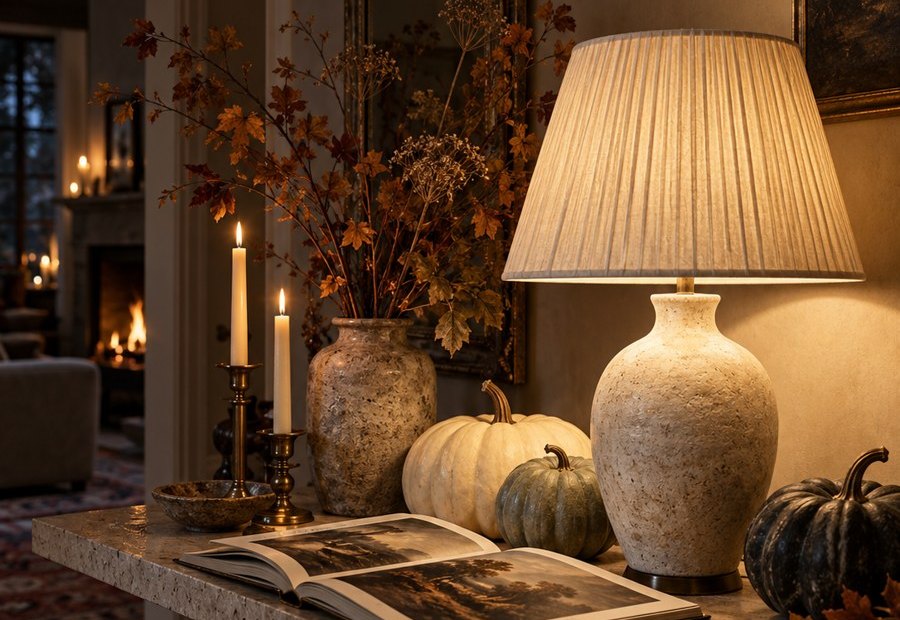
Most British living rooms are lit by one bulb in the middle of the ceiling. It is the cheapest possible arrangement and the least flattering: light from directly overhead flattens faces, throws the corners into shadow and makes a room feel smaller after dark than it does at noon.
The fix is not a better ceiling light. It is more, smaller sources at different heights. Here is how to plan one, in the order a designer would do it.
On this page
- Why one ceiling light fails
- The five-source rule
- The three layers
- Layer one: the ceiling
- Layer two: floor and table lamps
- Layer three: wall lights
- Reading, and where the light must come from
- The television
- Switching, dimming and bulbs
- Six mistakes worth avoiding
- In short
- Common questions
Why one ceiling light fails
Three reasons, and they compound.
It comes from above. Overhead light casts shadows downwards: under the brow, under the nose, under the chin. It is the lighting of a passport photograph.
It leaves the edges dark. A room reads as large when its walls and corners are lit. A single central source lights the floor in the middle and lets the perimeter fall away, so the room feels like a cave with a bright patch in it.
It has one setting. On, or off. A living room is used for reading, for television, for conversation and for sitting doing nothing, and those four things want different amounts of light.
The five-source rule
The working number, used by people who light rooms for a living: a living room wants at least five light sources, and at least three of them below head height.
A typical set:
- A ceiling fitting.
- A floor lamp beside the main seat.
- A table lamp on a side table or console.
- A second table lamp across the room, on a shelf or a sideboard.
- A pair of wall lights, or a third lamp in the far corner.
Five sources at 300 lumens each will beat one at 1,500 every evening of the year, for the same electricity. The total you are aiming for is roughly 1,500 to 3,000 lumens in an average room, split across those five. For room-by-room figures, see how many lumens do I need.
The three layers
- Ambient — the general level. The ceiling fitting, and any wall lights washing the walls. This is the layer that sets how big the room feels.
- Task — light for doing something. A reading lamp beside a chair. It is the layer that decides whether the room is usable.
- Accent — light on an object: a picture, a plant, a shelf, a texture. It is the layer nobody notices and everybody feels.
Get one source into each layer and the room is already better than most. Get two into each and it is finished.
Layer one: the ceiling
The ceiling light is not the enemy. Doing all the work alone is.
Sizing. Add the room's length and width in metres and multiply by 10: that is a sensible diameter in centimetres. A 4m by 4m sitting room suggests about 80cm, which is larger than most people dare. The 5-Light LED Chandelier at 60cm, the Frosted 5 Glass Ball Chandelier at 67cm and the Modern Crystal Chandelier at 60cm all read properly in a real room.

Low ceilings. Below 2.4 metres, do not shorten a pendant. Change the fitting. A flush or semi-flush piece looks intentional where a squeezed pendant looks like a compromise: the Sputnik Chandelier, the Crystal Flush Chandelier or the Nordic Glass Ceiling Light.
Height, if you do hang a pendant. Leave at least 2.1 metres of clearance beneath it in a circulation space. The full set of numbers is in our guide to how high a pendant light should hang. Browse ceiling lights and chandeliers for the whole range.
Layer two: floor and table lamps
This is the layer that does the emotional work, and the one most rooms are missing.
Floor lamps. Beside an armchair or at the end of a sofa, the bottom of the shade should sit at roughly 100 to 120cm from the floor, which is eye level for someone sitting down. Most floor lamps stand 150 to 180cm overall. The Pebble Floor Lamp is a soft, layered fabric shade for a corner; the Nordic Floor Lamp adjusts, which matters beside a reading chair; the Rice Paper Floor Lamp at 123cm glows rather than points, and belongs in a corner as ambient light rather than task light. Heights, shades and placement are in our guide to choosing a floor lamp.

Table lamps. On a side table, the bottom of the shade wants to land at about eye level for a seated adult, which usually means a lamp 40 to 55cm tall on a 55cm table. The Ceramic Table Lamp and the Marble Table Lamp have the weight a living room wants; the Amber Glass Mushroom Lamp is the warm, low, evening one.
The proportions — lamp height against table height, shade width against base — are set out in our guide to what size table lamp do I need.
The corner rule. Put a light in the darkest corner of the room, even if nobody sits there. Lighting a corner is the cheapest way to make a room feel bigger, and it costs one lamp. If there is no socket, a rechargeable lamp solves it without a cable across the floor.
Layer three: wall lights
Wall lights are the layer British homes skip, and the one hotels never do. They light the walls rather than the floor, which is exactly what makes a room feel considered.
- Mounting height: 150 to 165cm to the centre of the fitting, a little below standing eye level.
- Spacing: 200 to 250cm apart along a wall, or symmetrically either side of a fireplace, a sofa or a chimney breast.
- In pairs. A single wall light looks like an accident; two look like a decision.
For an up-and-down wash, the Stone Half-Circle Sconce and the Travertine Eclipse Sconce graze the wall. For something more decorative, the Crystal Wall Light or the Nordic Living Room Sconce. The whole range is in wall lights.

No wiring in the walls ? A Rechargeable Wall Light mounts with adhesive or two screws, dims by remote and needs no electrician. It is the single easiest upgrade in this guide.
Reading, and where the light must come from
A reading light has one rule: it should come over your shoulder, from behind and to the side, not from in front. Light from in front hits the page and bounces into your eyes.
Position the lamp so the bottom of the shade is at or just below the level of your eyes when seated, roughly 100 to 120cm, and about 50cm to the side of your shoulder. You want 400 to 600 lumens at the page, which is far less than people assume.
For a chair with no room for a floor lamp, an adjustable wall light does the same job: the Adjustable Reading Sconce swings out over the shoulder and folds back against the wall.
The television
Two problems, both easy.
Reflections. Nothing bright should sit opposite the screen, and no bare bulb should be visible in it. Move the offending lamp, or fit a shade that hides the source.
Contrast. Watching a bright screen in a dark room is tiring. A low light behind or beside the television — a small table lamp on the unit, a lamp in the corner — reduces the contrast and is easier on the eyes for a whole evening. Keep it warm and keep it dim.
Switching, dimming and bulbs
Split the switching. The single biggest improvement you can make without buying a fitting is to stop having one switch. Lamps on plug sockets, controlled independently, give you a room for reading and a room for television without rewiring anything. If the room opens onto a kitchen, see open-plan lighting for how to zone it.
Dim what you can. A living room at full output is a waiting room. If your ceiling fitting is not dimmable, leave it off in the evening and let the lamps do the work: that is the arrangement most people find they prefer anyway.
Bulbs: 2700K, CRI 90 or above, everything matching. One cool-white bulb among four warm ones will draw your eye every time you walk in. The full argument is in our guide to choosing colour temperature.
Six mistakes worth avoiding
- One ceiling light doing everything. The root of nearly every badly lit room in Britain.
- A ceiling fitting that is too small. Use the room-size rule: length plus width in metres, times 10.
- Nothing below head height. At least three of your five sources should be at table or standing-lamp height.
- Dark corners. They shrink the room more than any wall colour.
- Mixed colour temperatures. One odd bulb spoils four good ones.
- Everything on one switch. A room with one setting has one use.
In short
- Five sources, at least three below head height.
- Ceiling fitting diameter: (length m + width m) x 10 in cm.
- Floor and table lamps: bottom of the shade at 100 to 120cm, seated eye level.
- Wall lights: 150 to 165cm to the centre, 200 to 250cm apart, always in pairs.
- Reading light: over the shoulder, 400 to 600 lumens.
- Total for the room: 1,500 to 3,000 lumens.
- Bulbs: 2700K, CRI 90+, all matching.
Common questions
How many lights should a living room have ?
At least five separate sources, with three of them below head height: a ceiling fitting, a floor lamp, two table lamps and a pair of wall lights is the standard set. Five modest sources beat one bright one.
How bright should a living room be ?
Roughly 1,500 to 3,000 lumens in total for an average room, split across several fittings rather than concentrated in one. Individual reading lamps need only 400 to 600 lumens each.
How high should living room wall lights be ?
150 to 165cm from the floor to the centre of the fitting, just below standing eye level, and 200 to 250cm apart along a wall. Fit them in pairs, symmetrically about a fireplace or a sofa.
Where should a floor lamp go in a living room ?
Beside the main seat, slightly behind the shoulder, with the bottom of the shade 100 to 120cm from the floor. A second one in the darkest corner will do more for the room than any other single purchase.
What size ceiling light for a living room ?
Add the room's length and width in metres and multiply by 10 for a diameter in centimetres: a 4m by 4m room suggests about 80cm. Below a 2.4m ceiling, choose a flush or semi-flush fitting instead of a pendant.
What colour light is best for a living room ?
2700K warm white, with a CRI of 90 or above, and every bulb in the room matching. Cooler temperatures such as 4000K belong on a desk, not in a room used in the evening.
How do I light a living room with no ceiling light ?
Entirely with lamps, and it works well. Four or five plug-in sources at different heights, a pair of rechargeable wall lights for the walls, and one lamp in the darkest corner will light a room better than most pendants.
Start with one lamp
If the room has one ceiling light and nothing else, do not plan the whole scheme. Buy one floor lamp, put it beside the chair you actually sit in, and switch the big light off for an evening. That one change tells you everything the rest of this guide argues.
If you want a hand planning a particular room, send us the dimensions and a photo at contact@thelightheritage.com. We answer every message ourselves.
Browse living room lighting, floor lamps, table lamps and wall lights, or start with our bestsellers.