The hallway is the first room anyone sees and the last one anyone plans. It is usually narrow, usually windowless, and in most British houses it has a ceiling that will not take the light you actually want.
That last constraint is the one worth solving first, because it decides everything else. Here is how to work out what fits, and what to do with the space once you know.
On this page
- Work out your maximum drop
- Flush, semi-flush, or pendant
- How many fittings, and how far apart
- Wall lights, the narrow hallway's answer
- Stairs and landings
- A hallway with no daylight
- The front door, inside and out
- Bulbs and switching
- Five mistakes worth avoiding
- In short
- Common questions
Work out your maximum drop
One measurement decides what you can buy.
Measure floor to ceiling, then subtract 210cm. What is left is the total height of fitting you can hang, including its drop.
The 210cm figure is clearance: a standard British internal door is 198cm, so 210cm keeps the bottom of any fitting above the head of a tall visitor carrying a box. It is the one number in a hallway you should not negotiate with.
- 2.2m ceiling — 10cm to play with. Flush only.
- 2.3m ceiling — 20cm. Flush, or a very shallow semi-flush.
- 2.4m ceiling, the commonest in post-war Britain — 30cm. Semi-flush territory.
- 2.6m and above, a Victorian or Edwardian hall — 50cm or more, and you can hang something properly.
Measure at the lowest point if the ceiling steps down, and remember the fitting's depth is measured with the bulb in.
Flush, semi-flush, or pendant
Flush fittings sit tight against the ceiling with no visible gap. They are the correct answer below 2.3m, not a compromise: the Glass LED Ceiling Light at 25 or 28cm across, the Minimalist Cylinder, and the Flush Corridor Light, which is made for exactly this run.

Semi-flush fittings hang 15 to 30cm below the ceiling. They give a hallway some presence without stealing headroom: the Sputnik Chandelier at 70cm wide but only 20cm deep, the Crystal Flush Chandelier, or the Travertine Stone Ceiling Light for something quieter.

Pendants belong in a hall with a high ceiling, or above a stairwell where the drop has somewhere to go. If you have the height, a Rustic Copper Dome or the Travertine Stone Pendant makes an entrance of the entrance. The clearance rules for every room are in our guide to how high a pendant light should hang.
One trick for a wide, low hall: go wider rather than deeper. A 50cm flush fitting reads as generous where a 25cm one reads as apologetic, and it costs no headroom at all. Browse the full range in ceiling lights and hallway lighting.
How many fittings, and how far apart
A hallway is a corridor, not a room, so it wants a rhythm rather than a centre.
- One fitting every 200 to 250cm along the length.
- The first fitting about 100cm from the end wall, not hard against it.
- In a hall under 3 metres, one central fitting is enough.
- In a hall of 4 to 5 metres, use two. Three in anything longer.
Two modest fittings will always beat one bright one in a corridor, for the same reason a single central light fails in a living room: an evenly lit passage feels longer and wider, and a single bright source in the middle makes both ends feel like tunnels.
Wall lights, the narrow hallway's answer
In a hall under about 110cm wide, a ceiling fitting of any size starts to feel close. Wall lights solve it: they take no headroom, they light the walls rather than the floor, and lit walls are what make a narrow space feel wider.
- Height: 150 to 160cm to the centre of the fitting.
- Spacing: every 200cm or so along one wall.
- In a narrow hall, keep them to one side only. Facing pairs in a corridor create glare at eye level.
- Choose something shallow. Anything projecting more than about 12cm becomes a shoulder hazard.

The Nordic Corridor Sconce projects 5cm, which is about as flat as a wall light gets. The Eclipse Wall Light at 20cm across and 5cm deep does the same job as a disc of light, and the Retro Staircase Sconce is the period answer in an older house. For something with more presence where the hall allows it, the Travertine Wall Light or the Brass Arm Sconce. The whole range is in wall lights.
No wiring in the hallway walls, which is usual ? A Rechargeable Wall Light mounts with two screws and dims by remote, and the rest of the cordless range does the same. It is the only way most people will ever get wall lights into a rented or finished hall.
Stairs and landings
Stairs are the one place in a house where lighting is a safety matter rather than a decorative one.
- No step should be in shadow. Stand at the top and at the bottom and look: if a tread disappears, add light.
- Light the treads, not the risers. Light arriving from above and in front shows the edge of each step; light from directly overhead flattens them into one surface, which is how people miss the bottom step.
- Two-way switching, top and bottom. If you have to climb the stairs in the dark to turn them off, they will be left on.
- 2.1 metres of clearance above the highest step that a fitting passes over.
A tall stairwell is the one place in a modest British house where a long fitting genuinely belongs, hung to be seen from below as well as from the landing. If yours is a straight flight against a wall, a pair of sconces at 150cm above the pitch line — the imaginary slope joining the nose of each step — is more useful and more elegant than anything on the ceiling.
A hallway with no daylight
Most halls have no window, which changes the job: you are not supplementing daylight, you are replacing it.
Four things that work:
- Light the far end. A lit end wall pulls the eye through and makes the hall read as longer. A wall light or a small lamp on a console does it.
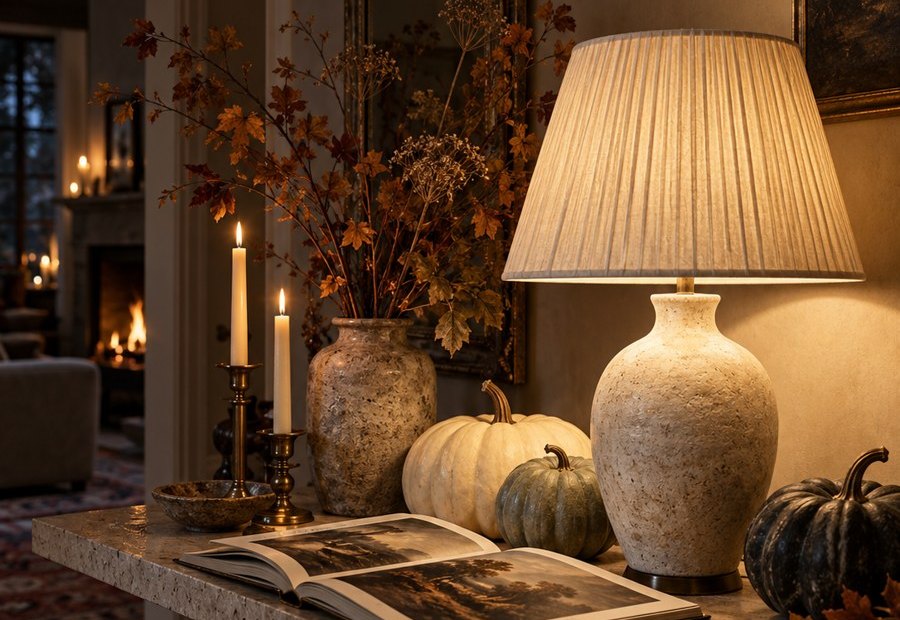
- Put a lamp in the hall. A console table with a table lamp is the single biggest change you can make: it brings light down to waist height and makes a corridor feel like a room. A Wood Table Lamp or a Rechargeable Mushroom Lamp will do, and the second needs no socket.
- Use a mirror opposite a light, not opposite a wall. It doubles the light rather than the emptiness.
- Keep the shades pale. In a dark corridor, an opaque dark shade sends all its light to the floor.
The front door, inside and out
The inside and the outside of a front door are one piece of lighting, and they are almost never treated as such. A warm light in the hall behind a warm lantern outside reads as welcoming from the street; a cold hall behind a warm porch reads as an office.
The heights, the lock-side rule and the IP ratings for the outside half are in our guide to where to put an outdoor wall light, and everything for it is in outdoor lighting.
Bulbs and switching
2700K. A hall is the first thing you see coming in from a cold street, and it should feel warm before you have taken your coat off. Cool white in a hallway is the most common and the most dispiriting bulb choice in Britain. The full reasoning is in our guide to choosing colour temperature.
Brightness: less than you think. 800 to 1,200 lumens in total is plenty for a hallway. It is a space you pass through, and your eyes are usually adjusting from somewhere darker or brighter.
Switching. Two-way switching at both ends of a hall and both ends of a staircase is worth the electrician's time. And a low-level source left on in the evening — a lamp on the console, or a cordless wall light — makes a house feel occupied from outside.
Five mistakes worth avoiding
- Hanging a pendant in a 2.3m hall. It will be ducked under for as long as you own the house.
- One bright light in the middle. It makes both ends of the corridor darker by comparison.
- A fitting that is too small. Go wide rather than deep: width costs no headroom.
- Wall lights facing each other in a narrow hall. Glare at eye level, from both sides.
- Cool white. It undoes the welcome before anyone has hung up a coat.
In short
- Maximum drop: ceiling height minus 210cm.
- Under 2.3m: flush. 2.4m: semi-flush. 2.6m and over: a pendant.
- Spacing: one fitting every 200 to 250cm, first one 100cm from the end wall.
- Wall lights: 150 to 160cm high, every 200cm, one side only in a narrow hall.
- Stairs: 2.1m clearance, two-way switching, no step in shadow.
- Total light: 800 to 1,200 lumens, at 2700K.
Common questions
What lighting is best for a hallway with a low ceiling ?
A flush fitting below 2.3 metres and a semi-flush at 2.4 metres. Work out your maximum drop by subtracting 210cm from your ceiling height: that figure is the tallest fitting you can hang while keeping safe head clearance.
How far apart should hallway lights be ?
Every 200 to 250cm along the length, with the first fitting about 100cm from the end wall. One central light is enough in a hall under 3 metres; use two in a hall of 4 to 5 metres.
How high should hallway wall lights be ?
150 to 160cm from the floor to the centre of the fitting, spaced about 200cm apart. In a narrow hallway, keep them to one wall only, and choose a design that projects less than about 12cm.
Can you put a pendant light in a hallway ?
Only if the ceiling allows 210cm of clearance beneath the bottom of the shade. That needs about 2.6 metres of ceiling for a pendant of any real presence; below that, a semi-flush fitting looks intentional rather than squeezed.
How do you light a dark hallway with no windows ?
Light the far end wall to draw the eye through, add a lamp at waist height on a console, hang a mirror opposite a light rather than opposite a blank wall, and keep shades pale so they do not send all their light to the floor.
How bright should a hallway be ?
800 to 1,200 lumens in total, split across two fittings if the hall is long. A hallway is a space you pass through, and over-lighting it makes the rooms leading off it feel dim by comparison.
How should stairs be lit ?
So that no tread is in shadow, with light arriving from above and in front to show the edge of each step, and with two-way switches at the top and bottom. Keep 2.1 metres of clearance above the highest step any fitting passes over.
Measure before you look
Take one measurement — floor to ceiling — subtract 210, and only then start choosing. It turns an impossible category into a short list in about thirty seconds.
Send us your ceiling height and the width of your hall at contact@thelightheritage.com and we will tell you what fits. We answer every message ourselves.
Browse hallway lighting, ceiling lights and wall lights, or read the guide that goes with this one: how to light a living room.