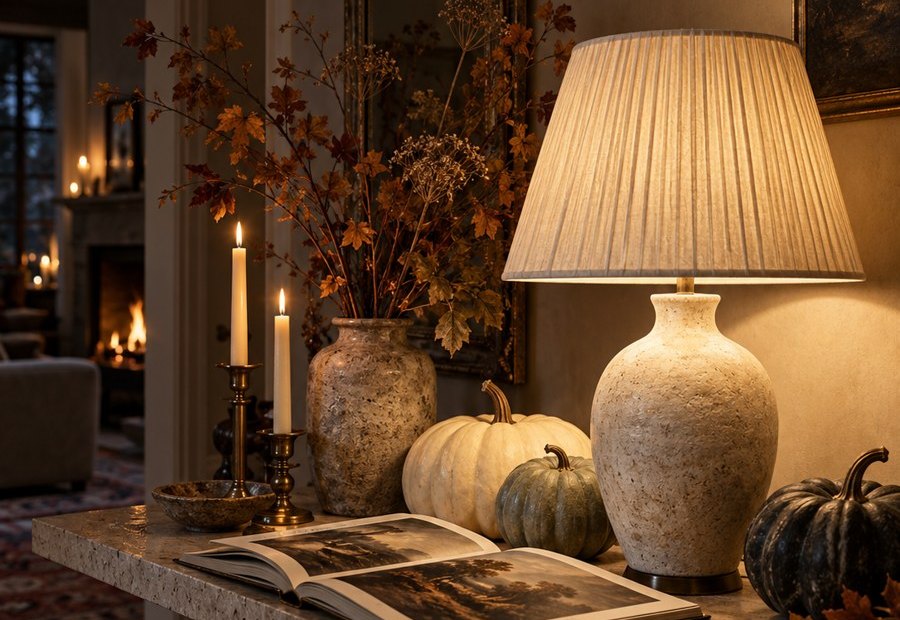
A lamp with the wrong shade looks wrong instantly and nobody can say why. Too small and it looks like a hat two sizes down. Too large and the base disappears underneath it.
There are three proportions that decide it, and they are all arithmetic you can do standing in front of the lamp with a tape measure.
On this page
- The three rules
- Shade sizes by base height
- Matching the shape
- UK shade fittings, explained
- Fabric, paper, glass or rattan
- Floor lamps and pendants
- Where the bottom of the shade should sit
- Five mistakes worth avoiding
- In short
- Common questions
The three rules
- Shade diameter should roughly equal the height of the base, measured from the table to the top of the lampholder. A 30cm base takes a shade about 30cm wide.
- Shade height should be about one third of the total lamp height. A 60cm lamp wants a shade around 20cm tall.
- The shade must be at least twice the width of the base at its widest point, and it must hide the bulb, the lampholder and any hardware completely when you look at it from standing height.
Where the three disagree, rule three wins. A shade that shows the lampholder is wrong at any size.
Shade sizes by base height
Measure your base from the table surface to the top of the lampholder, then read across.
| Base height | Shade diameter | Shade height | Typical use |
|---|---|---|---|
| 20cm | 22 – 28cm | 14 – 18cm | Small bedside, shelf, console |
| 30cm | 28 – 36cm | 18 – 22cm | Standard bedside lamp |
| 40cm | 36 – 45cm | 22 – 28cm | Living room side table |
| 50cm | 45 – 55cm | 28 – 34cm | Statement lamp, sideboard |
| 140 – 160cm (floor lamp) | 40 – 50cm | 25 – 35cm | Beside a sofa or armchair |
Our Fabric Table Lamp is 48cm tall with a 48cm shade, which sits at the generous end of the middle row and is why it reads as a living room lamp rather than a bedside one. The Cream Table Lamp is 50cm tall with a 30cm shade, a deliberately slimmer silhouette for a narrow bedside table.

Matching the shape
Proportion decides whether a lamp works. Shape decides what it says.
- Round or curved base → drum or empire shade. The Ceramic Table Lamp and the Marble Table Lamp are the classic version of this pairing.
- Square or angular base → square shade. Rare, and worth the trouble when the base deserves it.
- Tall, slim base → tall, narrow shade. A wide drum on a slim stem makes the lamp look like it is wearing something borrowed.
- Sculptural base → no shade at all. A mushroom or globe lamp is its own shade: the Wood Mushroom Lamp and the Amber Glass Mushroom Lamp solve the proportion question by removing it.
One more rule that saves a lot of regret: the shade should not overhang the table it stands on. A 45cm shade on a 40cm bedside table will be knocked every time someone reaches for a glass of water.
UK shade fittings, explained
Three fittings cover almost everything sold in Britain, and they are not interchangeable.
| Fitting | How it attaches | Usually found on |
|---|---|---|
| Ring (European) | Sits on the lampholder ring, held by the shade's own collar | Most UK table lamps and pendants |
| Gimbal | Sprung arms clip around the bulb holder | Wall lights, some table lamps |
| Duplex / spider | Sits on a separate carrier above the holder | Larger and antique lamps |
Two practical notes. Most ring shades are made for E27 and come with a reducer for E14, so check which holder your lamp has before ordering. And a shade bought abroad may not fit a UK lampholder at all, whatever the diameter says.
If you are unsure which cap your bulb takes, our guide to bulb fittings explained covers E27, E14, GU10, G9 and B22 in one page.
Fabric, paper, glass or rattan
The material changes the light more than the colour does.
- Linen and cotton — warm, even, forgiving. The safest choice in a living room, and what the Pebble Table Lamp and the Pleated Walnut Lamp use.
- Rice paper — the softest light of all, and the most fragile. The Rice Paper Table Lamp glows rather than lights.
- Rattan and bamboo — throws pattern as well as light, which is charming on a wall and distracting behind a book. The Rattan Ball Lamp and the Bamboo Table Lamp.
- Opal glass — even, modern, wipeable. Better than fabric in a kitchen.
- Dark or opaque shades — send nearly all their light up and down, and almost none sideways. Beautiful over a table, useless as a room light.
A pale lining matters as much as the outside. A shade with a white or gold lining puts light back into the room; a dark lining keeps it.
Floor lamps and pendants
Floor lamps. 40 to 50cm of shade on a lamp of 140 to 165cm. Below 35cm the shade looks starved on a full-height lamp. The Pebble Floor Lamp stands 155cm with a 42cm shade, which is the proportion working correctly; the Rice Paper Floor Lamp at 123cm with a 53cm lantern is deliberately squatter, and belongs in a corner rather than beside a chair. Height and placement are in our guide to choosing a floor lamp.
Pendants. Different rules entirely, because the reference is the furniture below rather than the base. Over a dining table, size the shade at half to two thirds of the table's narrow side — the full method is in what size pendant light for a dining table. Over an island, 25 to 35cm each in a row: see how many pendants over a kitchen island.
Where the bottom of the shade should sit
Size is half the job. Height is the other half, and it is the one that decides whether you get glare.
The bottom of the shade should sit at or just below your eye level when you are seated. In practice that is 100 to 120cm from the floor, which on a 55cm side table means a lamp of 45 to 65cm.
Sit down, look straight ahead, and if you can see the bulb, the lamp is too tall for that table or the shade is too shallow. The full set of heights by room — bedside, console, desk — is in our guide to what size table lamp do I need.
Five mistakes worth avoiding
- A shade that shows the lampholder. The one error you cannot decorate around.
- Buying by diameter alone. Height matters as much: a wide shallow shade and a wide deep one behave completely differently.
- A shade wider than the table. It will be knocked, and it makes the table look small.
- A dark shade as a room light. Opaque shades light the ceiling and the table top, nothing between.
- Assuming any shade fits any lamp. Ring, gimbal and duplex are three different fittings.
In short
- Shade diameter ≈ height of the base.
- Shade height ≈ one third of total lamp height.
- Minimum: twice the width of the base, and the holder must be hidden.
- Floor lamps: 40 to 50cm of shade.
- Bottom of the shade: 100 to 120cm from the floor, at seated eye level.
- Check the fitting — ring, gimbal or duplex — before the size.
Common questions
What size lampshade do I need for my lamp ?
Match the shade diameter to the height of the base, make the shade about a third of the lamp's total height, and never go narrower than twice the widest part of the base. A 30cm base takes a shade of roughly 28 to 36cm.
How do I measure a lampshade ?
Measure the diameter across the bottom of the shade, the diameter across the top, and the slant height down the side. Shades are usually listed by their bottom diameter.
Should the lampshade be wider than the base ?
Yes, always. The shade should be at least twice the width of the widest part of the base, and it must completely hide the bulb and lampholder when viewed from standing height.
What size lampshade for a floor lamp ?
40 to 50cm in diameter for a lamp standing 140 to 165cm, with the shade 25 to 35cm deep. Anything under 35cm looks undersized on a full-height floor lamp.
What lampshade fitting do UK lamps use ?
Most use a ring fitting that sits on the lampholder, usually sized for E27 with a reducer for E14. Wall lights often use a sprung gimbal, and larger or antique lamps use a duplex ring on a separate carrier.
How high should the bottom of a lampshade be ?
100 to 120cm from the floor, which is eye level for a seated adult. If you can see the bulb while sitting down, the lamp is too tall for the table it is on.
Does the lampshade colour change the light ?
Considerably. A pale or gold-lined shade puts light back into the room; a dark or opaque one sends nearly all of it straight up and down. Rattan and paper add texture to the light itself.
Two measurements, then buy
Height of the base, width of the base. Those two numbers give you a shade size, and everything else is taste.
If you have a lamp you love and no idea what fits it, send us a photo with the base height at contact@thelightheritage.com. We answer every message ourselves.
Browse table lamps and floor lamps, where the shade and base are already matched, or start with our bestsellers.