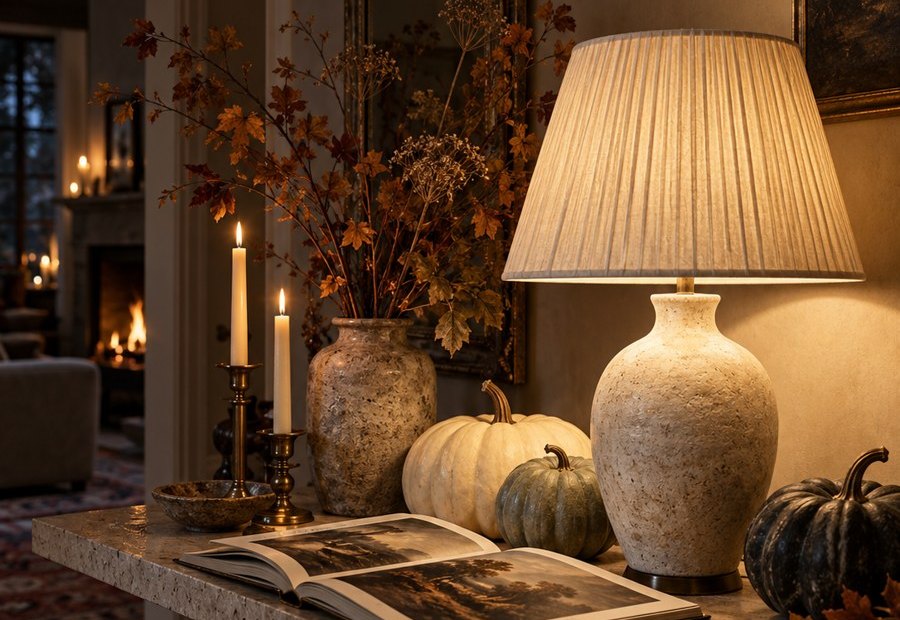
Japandi is what happens when Japanese restraint meets Scandinavian warmth: pale timber, linen, paper, stone, few objects and a lot of calm. More than most styles, it lives or dies by its lighting. Get the lights wrong, too bright, too shiny, too many, and a Japandi room looks merely bare. Get them right, and it looks serene.
Here is how to light a Japandi room, which materials to look for and which mistakes to avoid.
On this page
- The four principles of Japandi light
- The materials, and what each does to the light
- The living room
- The bedroom
- The dining table and kitchen
- What to avoid
- In short
- Common questions
The four principles of Japandi light
- Low and warm. Light sits close to where you are, at table and floor level, rather than blazing from the ceiling. Colour temperature stays at 2700 to 3000K.
- Diffused, never bare. Light passes through paper, linen, stone or woven fibre. You see a glow, not a bulb.
- Natural materials. Wood, paper, stone, rattan, linen and ceramic. Metal, where it appears, is matt black or quiet brass, never chrome.
- Fewer, better pieces. One sculptural lamp makes a Japandi room; five competing ones unmake it.
Behind all four sits the Japanese idea of wabi-sabi: beauty in what is simple, natural and slightly imperfect. A handmade paper shade with an uneven texture is not a flaw here. It is the point.
The materials, and what each does to the light
| Material | The light it gives | From our range |
|---|---|---|
| Rice paper | A soft, even, lantern-like glow | Rice Paper Floor Lamp, Rice Paper Table Lamp |
| Travertine and stone | Light grazing a textured surface, warm and mineral | Travertine Eclipse Wall Light, Travertine Semi-Flush Light |
| Wood | A warm frame for the light, a natural grain | Wood Linear Pendant, Wood Mushroom Table Lamp |
| Rattan, bamboo and rope | Patterned shadows on walls and ceiling | Rattan Table Lamp, Hemp Rope Pendant |
| Hand-moulded matte resin | A soft, organic dome of light | Wabi-Sabi Pendant |
Browse the full travertine and stone and bamboo and rattan collections. Our guide to rattan and bamboo lights goes deeper into woven shades.
The living room
Start low. A paper floor lamp in the corner does more for a Japandi living room than any ceiling light. The Rice Paper Floor Lamp stands 123cm tall with a 53cm handmade paper shade and gives a gentle, low-glare glow; it comes with its E27 bulb.
Add one light on the wall to give the room depth. A stone wall light such as the Travertine Eclipse Wall Light, 20cm across, or the Travertine Disc Wall Light, 25cm, turns a bare plaster wall into a feature without a single picture on it.

If you need a ceiling light, keep it close to the ceiling and quiet: the Travertine Semi-Flush Light, 22cm, in a walnut or wood-tone finish with warm 3000K light. Our guide to lighting a living room sets out the three layers.
The bedroom
The Japandi bedroom is the calmest room in the house, and its light should be the softest.
- Bedside: a pair of paper or rattan lamps. The Rice Paper Table Lamp, 47cm on a slim tripod, is inspired by the Japanese paper lantern tradition. The Rattan Ball Table Lamp, 45cm, and the Rattan Cylindrical Table Lamp, 47cm, give warm 3000K light through a woven shade.
- Or a hanging bedside light, which frees the bedside table entirely: the Travertine Bedside Pendant or the Travertine and Wood Pendant, with its warm 3000K G9 bulb.
- No bright overhead light in the evening. If there is one, put it on a dimmer.

Our guide to lighting a bedroom gives the heights for bedside lamps and pendants.
The dining table and kitchen
Over a dining table, one long, low line of light suits the style better than a cluster of shiny pendants. The Wood Linear Pendant, in wood or walnut, comes in 80, 100 and 120cm lengths with dimmable integrated LED: choose a length roughly two-thirds of the table.
For a softer, more sculptural piece, the Wabi-Sabi Pendant, 30 or 50cm, has a hand-moulded, matte white resin shade with the organic shape the style loves. Over a kitchen island, the same pendant, or the marble-effect Japanese Cream Pendant, works in a row.
For sizes and heights, see what size pendant for a dining table and how high a pendant should hang.
What to avoid
- Cool white light. 4000K and above turns paper and wood grey and clinical. Stay at 2700 to 3000K. Our guide to colour temperature explains why.
- Chrome and gloss. Shiny finishes fight the matt, natural palette. Matt black, brushed brass or wood are the metals of the style. See our guide to choosing a lighting finish.
- Too many fittings. Three or four well-placed sources are enough for most rooms.
- Bare bulbs at eye level. The style hides the bulb. Save filament bulbs for industrial rooms.
- Everything in one material. Mix paper, stone and wood. An all-rattan room tips into boho; Japandi is quieter.
In short
- Light low and warm, 2700 to 3000K.
- Always diffused: paper, linen, stone, woven fibre.
- Natural materials, matt metals, no chrome.
- One sculptural lamp per room, not five.
- A paper floor lamp in the living room, paper or rattan lamps by the bed, a long wooden line over the table.
Common questions
What lighting suits a Japandi interior ?
Warm, diffused light at low level: paper lanterns, stone wall lights, rattan table lamps and simple wooden pendants, all at 2700 to 3000K. The bulb should be hidden behind the shade rather than on show.
What colour temperature is best for Japandi ?
2700 to 3000K, warm white. Cooler light makes natural materials like paper and wood look grey and flat.
Are paper lamps Japandi ?
Yes, they are one of its signatures. The tradition of paper lanterns, made famous by the Akari light sculptures Isamu Noguchi designed from 1951, is at the heart of the Japanese side of the style.
Is rattan Japandi or boho ?
Both, depending on how it is used. In a Japandi room, rattan is one material among several, paired with plain wood, stone and linen. Used everywhere with bright textiles and plants, it reads as boho.
What metal finish goes with Japandi ?
Matt black or brushed brass in small quantities, and natural wood wherever possible. Avoid chrome and high-gloss finishes.
How many lights does a Japandi room need ?
Usually three or four sources at different heights, such as a floor lamp, a table lamp and a wall light, with any ceiling light on a dimmer.
Still unsure ?
Send us a photo of your room at contact@thelightheritage.com and we will suggest the two or three pieces that would make the biggest difference. We answer every message ourselves.
Browse travertine and stone, bamboo and rattan, table lamps and floor lamps. And for the opposite mood, metal and exposed bulbs, see our guide to industrial lighting.