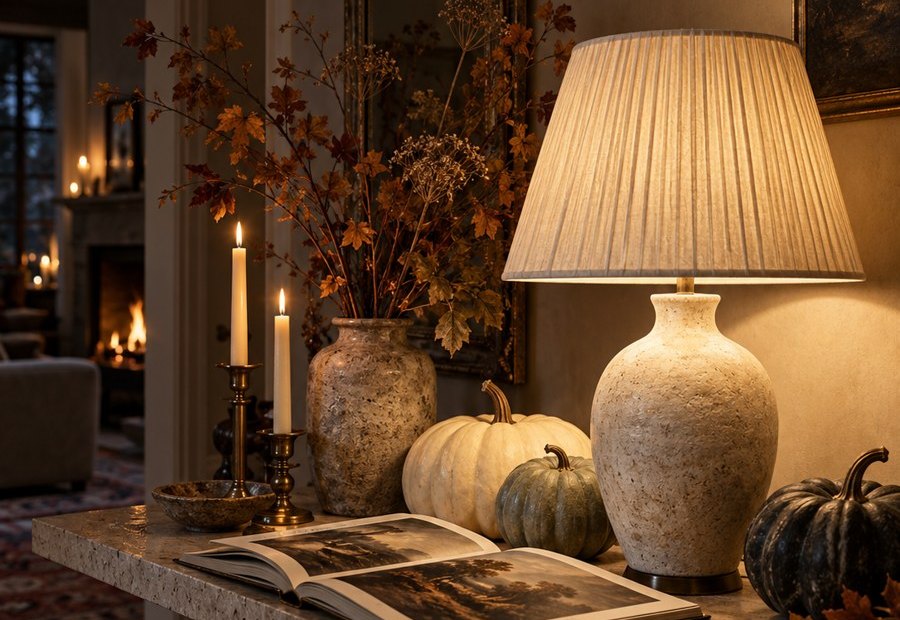
A woven shade does something no glass or fabric shade does: it does not soften light, it draws with it. The weave throws its own pattern onto the walls and ceiling, and that pattern becomes part of the room.
Which is why these pieces are either the best decision in a room or the most distracting one. Here is how to tell which you are about to make.
On this page
- What a weave does to light
- The materials, compared
- Open weave or closed weave
- The bulb that ruins them
- Sizing: go one up
- Where they work, and where they do not
- Living with them
- Five mistakes worth avoiding
- In short
- Common questions
What a weave does to light
An opal glass shade diffuses: light enters, scatters, and leaves evenly in every direction. A linen shade absorbs a little and passes the rest, warmed.
A woven shade does neither. It blocks light where the fibre is and passes it where the gaps are, so what leaves the shade is not a glow but a projection — stripes, lattices, honeycomb — cast onto whatever surrounds it.

Two consequences follow, and they explain almost everything else on this page:
- The room does the work. A woven pendant against a plain pale wall is beautiful; the same piece against wallpaper or a gallery wall is noise on top of noise.
- The bulb is visible through the gaps. That is fine at low output and unbearable at high.
The materials, compared
| Material | What it is | Lit, it gives | Best in |
|---|---|---|---|
| Rattan | Solid palm stem, peeled and woven | Warm amber tone, crisp shadows | Bedrooms, living rooms, over islands |
| Bamboo | Hollow grass, split into strips | Paler, more graphic, straighter lines | Dining, kitchens, hallways |
| Raffia / seagrass | Palm leaf fibre | Soft, fuzzy edges, very warm | Bedrooms, snugs |
| Hemp rope | Twisted natural cord | Dense, little pattern, strong silhouette | Anywhere you want shape without shadow play |
| Rice paper | Paper over a frame | A pure even glow — no pattern at all | Bedrooms, corners, low light |

Rice paper is the outlier: it is the only one of the five that behaves like a diffuser rather than a filter. The Rice Paper Table Lamp and the 123cm Rice Paper Floor Lamp glow; they do not draw. For the whole style, see Japandi lighting.
Open weave or closed weave
This is the choice that decides how much of the room the fitting takes over.
Open weave — wide gaps, visible bulb, strong shadows thrown several metres. Dramatic, and best where there is plain surface to receive the pattern. The Butterfly Bamboo Pendant at 50cm is the clearest example: it lights the room by decorating it.

Closed weave — tight fibre, bulb hidden, light mostly out of the top and bottom. Calmer, and the safer choice over a dining table or in a room that already has pattern. The Rattan Boho Pendant at 30cm and the Hemp Rope Pendant sit at this end.
Between them, the Woven Bamboo & Wood Chandelier in 45 or 55cm and the Rattan Cluster give pattern without taking the room over.
The bulb that ruins them
The single most common error with a woven shade is a bright bulb.
Behind a tight weave, a high-output bulb produces glare through every gap at eye level — the opposite of the calm these pieces are bought for. And because the weave concentrates heat, an oversized bulb is also the one thing that will dry and discolour the fibre over time.
- 400 to 600 lumens, not more, in a pendant or a table lamp.
- 2700K, always — natural fibre is warm, and a cool bulb behind it looks grey and dead.
- Opal or frosted glass, not clear. A visible filament behind an open weave is two patterns fighting.
- Most of ours take E27, so you can change your mind later — see bulb fittings explained.
The full reasoning on temperature and CRI is in choosing colour temperature.
Sizing: go one up
A woven shade reads smaller than a solid shade of the same diameter, because you can see through it. Its visual weight is lower.
So wherever a sizing rule gives you a number, take the top of the range, or go one size up:
- Over a dining table: half to two thirds of the narrow side, and choose the two thirds — see what size pendant light for a dining table.
- In a row over an island: 30 to 35cm rather than 25 — see how many pendants over a kitchen island.
- On a lamp base: the usual proportions, at the generous end — see what size lampshade do I need.
Where they work, and where they do not
Bedroom — the best room for them. Low light, plain walls, and the pattern is something to look at from the bed. The Rattan Ball Lamp and the Rattan Cylindrical Lamp at 47cm are bedside-sized. Heights in how to light a bedroom.
Living room — yes, as one of several sources. Never as the only light: a weave sends too little sideways. See how to light a living room.
Over a dining table or island — yes, closed weave. You want the light on the table, not on the ceiling.
Hallway — yes, if it clears 210cm. Woven shades are light, which matters on a plasterboard ceiling. Below that height, look at a flush fitting instead: flush, semi-flush or pendant.
Kitchen, away from the hob — with caution. Airborne grease binds to fibre and cannot be washed out. Never directly over a hob.
Bathroom — no. Humidity swells natural fibre, and it does not recover. Nor is any woven shade rated for the zones: bathroom lighting zones explained.
Outdoors — no. Not even under a porch.
Living with them
- Dry cleaning only. A soft brush, or a vacuum on its lowest setting with a stocking over the nozzle. Water swells the fibre and leaves marks that do not fade.
- Expect the colour to move. Natural fibre lightens in direct sunlight and warms with age. This is not a fault; it is the material.
- Handle by the frame, not the weave, when you take it down.
- Full method by material in how to clean a chandelier.
One design advantage worth knowing: because they are not a metal, woven shades mix with every finish in the house — brass, black, chrome alike. They are the easiest thing to add to a scheme you have not finished deciding, as set out in choosing a lighting finish.
Five mistakes worth avoiding
- A bright bulb behind a weave. Glare through every gap, and heat on the fibre.
- An open weave against a patterned wall. The shadows need a plain surface to land on.
- A woven shade as a room's only light. Too little goes sideways.
- Buying the same diameter as a solid shade. Go one size up.
- Anywhere humid. Bathrooms and porches end the same way.
In short
- A weave patterns light; it does not diffuse it. Only rice paper diffuses.
- Open weave for plain rooms and drama, closed weave over tables and in busy rooms.
- Bulb: 400 – 600 lumens, 2700K, opal.
- Go one size up — a weave reads smaller than it measures.
- Best in bedrooms; never in bathrooms or outdoors.
- Clean dry, always.
- Mixes with every metal finish.
Common questions
What is the difference between rattan and bamboo ?
Rattan is a solid palm stem, peeled and woven, and it glows a warm amber when lit. Bamboo is a hollow grass split into strips, so it reads paler and more graphic, with straighter lines in the pattern it casts.
Do rattan lights give enough light ?
As one of several sources, yes. As a room's only light, no: a weave sends most of its light up and down and relatively little sideways. Pair one with a table or floor lamp.
What bulb should I use in a rattan or bamboo shade ?
400 to 600 lumens at 2700K, in opal or frosted glass rather than clear. A bright bulb glares through the gaps at eye level and dries the fibre over time.
Can you put a rattan light in a bathroom ?
No. Humidity swells natural fibre and it does not recover, and no woven shade carries the IP rating the bathroom zones require. The same applies outdoors, even under a porch.
How do you clean a rattan or bamboo light shade ?
Dry only — a soft brush, or a vacuum on its lowest setting with a stocking over the nozzle. Water marks the fibre permanently and can swell the weave.
What size rattan pendant should I buy ?
One size up from what a sizing rule gives you. A woven shade is partly see-through, so it carries less visual weight than a solid shade of the same diameter.
Do rattan lights go with brass or black fittings ?
With both. Natural materials are not a metal, so they do not compete with one — which makes them the easiest pieces to introduce into a room whose finish you have not settled.
Switch one on against a plain wall
If you are unsure whether a weave is right for a room, look at where its shadows would land. Plain plaster, and it will be the best thing in the room. Wallpaper, and it will be the busiest.
Send us a photo of the wall and we will tell you which weave suits it: contact@thelightheritage.com. We answer every message ourselves.
Browse pendant lights, table lamps and chandeliers, or start with our bestsellers.